
Not long ago, I wrote an article on how to water succulents.
Sometimes, if you’re careless and over-water, or if the substrate in which the plant is growing doesn’t dry fast enough, the plant will still have too much water.

How to repair a watering accident on a fat plant?
In fact, my solution is relatively simple and doesn’t really merit a full article. But I didn’t want to simply add to the previous article on watering succulents, because this question is sometimes asked on search engines and in such cases you need a quick answer.
My quick fix:
Remove the plant from its pot and place it on absorbent paper until the soil is just moistened.
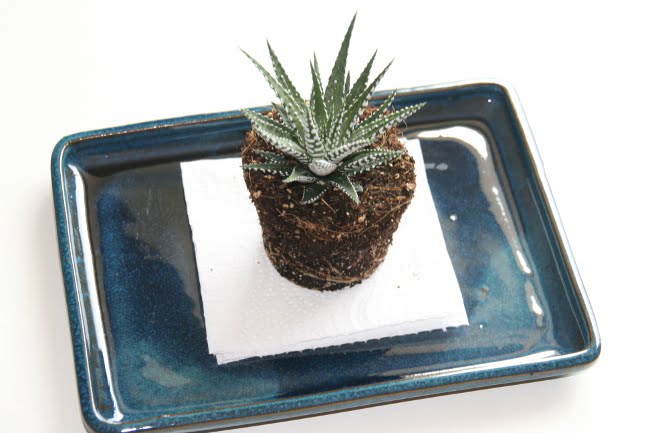
This problem of non-drying substrate occurs more often with plastic pots. That’s a good thing, because unpacking a composition covered in small gravels wouldn’t be very practical!
How can you tell if a plant is overwatered or has too much water?
Shortly after watering, 1 or 2 days, the plant wilts as if thirsty. Or it turns yellow and loses leaves. In this case, if you spot the problem 2 days after the last watering, you need to act fast.
Then leave the plant without water for a while. Observe your plant every day to understand its needs. Set it up behind glass in a sunny spot, where you’ll pass by every day.
Most of the time, when the plant has too much water, you can see that the soil is soggy, too wet and not just damp.
How do you save a succulent that has started to rot?
If it has started to rot, try to recover the parts of the plant that are still alive for cuttings. Wait a few hours or even days for the cut part to dry out. Then take a cutting. I explain how to do this here.
With Echeveria, the leaves must be removed.

